The 2026 SEO Directive: Mastering the Sovereign Funnel
10 min read•Published on December 27th, 2025 in Content County›Advanced Tech
Key Takeaways
The Death of Search and the Birth of the Sovereign Blog: A 2026 SEO Directive
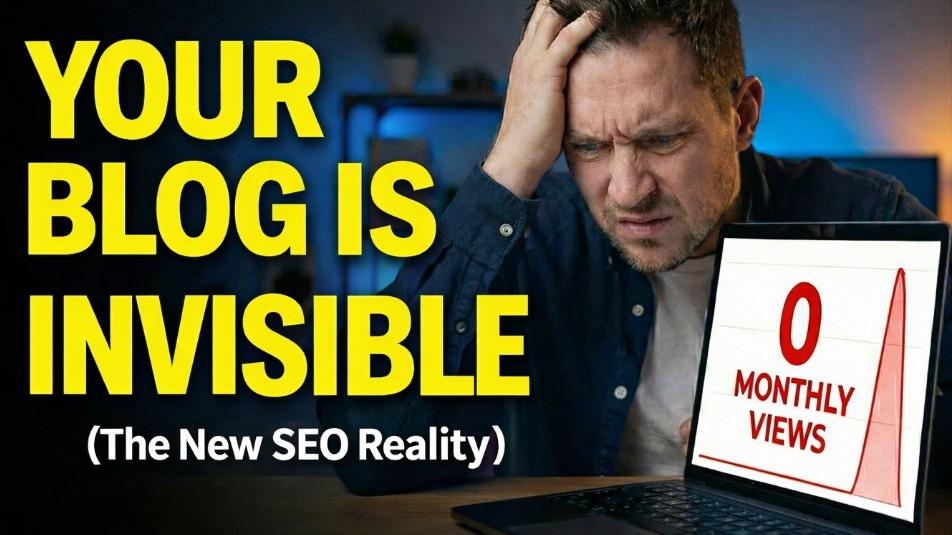
You’ve probably noticed the silence.
For years, the "gurus" told you that if you just wrote high-quality content and sprinkled in the right keywords, the traffic would come. You followed the rules. You built the site. You waited.
And yet, as we move into 2026, the traditional Google search has gone the way of the dinosaurs. The "ten blue links" that used to provide a steady stream of traffic to your entrepreneurial ventures have been replaced by a wall of AI-generated summaries. Who would have guessed that? Wow... the very foundations of how we communicate and trade online have shifted under our feet while most people were still arguing over meta descriptions.
Along with the old search engines, your keyword tactics and ranking schemes are dead. If you are still trying to "rank for keywords," you are playing a game that ended two years ago.
But hope isn't lost. In fact, for the man of high-frequency character (the one who values merit over noise) this is the single greatest opportunity for sovereignty in history. I’m going to show you exactly how vectors and entities have replaced keywords. I’m going to show you how "Legos" and "No-Click" strategies are the new tools of war for your blog.
How are you going to make this new baby? How are you going to build a platform that survives the "low-frequency" noise of the modern web?
The New Language: Not Being a Dinosaur
To survive, you have to stop being a dinosaur. The 2010s are over sorry.
If you are still looking at your blog as a collection of articles, you’ve already lost. The current technology revolves around two things: LLMs (Large Language Models) and Human Experience. Search engines no longer "read" your words; they "calculate" your meaning. This is called Vector SEO. Imagine every concept in the world as a coordinate on a massive, multidimensional map. When someone asks an AI a question, the machine looks for the "neighborhood" where the answer lives. If your blog post is mathematically located in the right neighborhood, you get cited. If not, you are invisible.
This is why Entities matter more than keywords. An entity is a specific, recognized "thing" like your brand, your name, or a specific venture system. Google and AI's are no longer looking for "how to get venture funding." They are looking for the Entity (the expert) who has the Experience (the proof) of getting that funding.
If you can’t understand this, your traffic will die. You will be screaming into a void that has been programmed to ignore you. But how do you actually implement this?
The Human Loophole: Listicles and User Content
First, you need to understand why Google is doing this. They are desperate. The internet is currently being flooded with mediocre AI text. It is low-frequency, "stuck" energy that provides no new value.
To combat this, the machines have developed a fixation on Human Consensus. This is where the "Reddit Loophole" comes in. Data from late 2025 suggests that AI models cite listicles and forum discussions more than almost any other content type.
Why? Because a listicle provides a structured, "Lego-like" framework that is easy for an AI to extract. And a Reddit thread provides "Social Proof" that real humans actually cared about the information.
If you are a leader, a "Sentinel" building a legacy, you cannot rely on just being "right." You have to be salient. You have to be the name that keeps popping up in third-party listicles. You have to be the authority that people are discussing in gated masculine intellectual communities.
But wait—don't most people say you should just "update your old posts"? High-level SEOs are now finding that major updates can actually "reset" your authority. Instead, the elite are using Micro-Updates and Interactive Tools.
The most successful blogs in 2026 aren't just text; they are Mini-Apps. Instead of a 3,000-word guide on "How to calculate ROI," the high-frequency entrepreneur builds a simple JavaScript calculator directly into the post. This creates "High Dwell Time", it makes people stay on your site, which is a signal to Google that your content is actually serving humanity.
So how do you solve this problem? How do you create LLM friendly vectors and entities while giving readers an experience that actually raises their frequency?
The Hybrid Fortress: Technicals and Controversies
You need a hybrid. You need a system that combines raw technical power with authentic spiritual and entrepreneurial merit. This is where we move into the "Command Center" of your blog.
1. The Direct Answer Protocol (AEO)
When you write, you must use what I call the "Direct Answer" protocol. The machine (the Answer Engine) is looking for a sentence it can steal.
-
Old Style: "In this article, we will explore the various facets of venture capital and how one might go about seeking it." (Dinosaurs).
-
New Style: "Venture funding is a merit based equity exchange where capital is provided to high potential startups in exchange for ownership." (Machines love this).
You must state the answer immediately in the first 40-60 words of a section. Be declarative. No fluff.
2. Edge SEO: The Sovereign Infrastructure
Most entrepreneurs are held back by their website's tech. Their WordPress or Shopify site is slow, rigid, and "reactive." To build a legacy, you need to move your logic to the Edge.
Using tools like Cloudflare Workers, you can inject "Schema Markup" (the secret code that tells AI what your site is about) without ever touching your actual website's backend. This is "High-Status" tech. It allows you to bypass the limitations of failing institutional platforms and manage your data sovereignty personally.
3. The Parasite Paradox: Renting Authority to Build a Dynasty
You’ve heard the whispers in the dark corners of the SEO forums—people calling it a "cheat code" or a "hack." They call it Parasite SEO. In a world where low-frequency noise is being purged by the machines, the "Parasite" label is a misnomer. I call it Strategic Positioning.
The Conflict: You are building a legacy. You have the "Entrepreneurial Grace" and the systems, but your brand-new domain is a ghost town. Google’s algorithms, specifically the late 2025 updates, are biased toward massive, established trust. They favor the giants. If you try to fight them head-on with a fresh URL, you aren't being a warrior; you're being a martyr.
The Solution: You must "rent" the reputation of the high-authority domains that Google already trusts. By publishing your most potent "Starting Systems" on platforms like LinkedIn Pulse, Medium, or even optimized Reddit threads, you bypass the "sandbox" period entirely.
-
The LinkedIn Pulse Kingmaker: Google treats LinkedIn articles as high-frequency, expert-led data. A well-structured article there can rank for a competitive term like "Venture Capital Strategy" in 48 hours, whereas your blog might take 48 weeks.
-
The Hidden Trap: Be warned. Google’s "Site Reputation Abuse" policy is the shield they use to protect their ad revenue. Do not lease subdomains of random news sites to post low-value spam. That is "low-frequency" behavior. Instead, use these platforms for Syndication. Publish the core value there, capture the high-ground, and then lead those high-intent readers back to your own "Command Center" (your self-hosted WordPress site) for the high-ticket manuals.
But a warrior is only as good as his steel. To execute this strategy at a high level, you cannot rely on disposable, consumer-grade tech.
4. The Top Tech Stack: Building Your Command Center
To operate at a high frequency, you need a technical infrastructure that is both "Active" and "Responsive." Most bloggers use tools that are reactive—they tell you what happened yesterday. You need tools that tell you what the AI will do tomorrow.
1. Rankability: The AI Extraction Predictor Stop guessing if your content is "good." Rankability uses IBM Watson and Google’s own NLP (Natural Language Processing) logic to predict exactly how a generative engine will extract your data. It gives you a "Citation Probability" score. If your score is low, you are wasting your breath.
2. InLinks: Semantic Entity Mapping Keywords are for the masses; Entities are for the elite. InLinks doesn't just look for words; it maps the "neighborhood" of your concepts. It automatically builds the JSON-LD Schema and internal links that tell Google's Knowledge Graph exactly where your blog fits in the hierarchy of human knowledge. It turns your blog from a list of posts into a "topical fortress."
3. Perplexity: The Source Hunter Perplexity isn't just a search tool; it’s a competitive intelligence platform. Use it to see which "Sources" the AI is currently favoring for your target topic. If the AI is citing a specific Reddit thread or a competitor’s case study, you now have your target. You don't just write a post; you write the Update to the consensus that forces the AI to cite you instead.
So, we have the strategy and we have the steel. Now, we execute the manual. Let’s put this all together into the Starting System that will secure your digital lineage.
Summary: The Starting System for the Sovereign Blog
You are not just a blogger. You are a lighthouse for humanity’s potential. Your blog is the "Starting System" for your legacy, and the "Sentinel" does not act without a blueprint. Here is your A-Z directive to develop your posts properly:
Step 1: Claim Your Entity (The Foundation)
Stop being an anonymous "content creator." That is a low-status position. You are a Founder. Use Person Schema to explicitly link your name, your social profiles, and your professional credentials to every post. This builds the E-E-A-T (Experience, Expertise, Authoritativeness, Trust) that the machines require before they will grant you a Knowledge Panel.
Step 2: The Reddit-First Method (The Intelligence Drill)
Before you spend 20 hours on a deep-dive post, publish a condensed, high-value version as a Reddit thread. If the community upvotes it, you have "Social Proof." Google sees that real humans find the data "helpful" before the crawler even touches your site. This "human signal" is the most powerful ranking factor in 2026.
Step 3: Optimize for Synthesis (The Modular Build)
The AI does not read your blog to "learn." it reads to "extract." Structure your posts in modular, self-contained blocks.
-
Use H-tags as questions.
-
Provide the answer in the first 50 words of the section.
-
Use bulleted listicles for comparisons. If your content is "easy to steal" for an AI overview, you will be the one they cite as the source.
Step 4: Inject Information Gain (The Warrior’s Edge)
The "Helpful Content" updates are designed to kill "me-too" content. If you are just summarizing what is already on Page 1, you have zero Information Gain. You must inject original research, proprietary case studies, or contrarian "Warrior Mindset" perspectives. One original data point is worth 1,000 pages of AI-spun fluff.
Step 5: Build the Interactive Tool (The High-Dwell Anchor)
Engagement is the new backlink. Build simple JavaScript tools—calculators, assessment quizzes, or interactive checklists—directly into the post. When a user spends 5 minutes interacting with a tool on your site, Google receives a "High-Dwell" signal. This proves your site is a utility, not just a document.
(Conclusion/Final CTA): And that is it. You are no longer playing the keyword game with the dinosaurs. You are building a mathematical and spiritual fortress of authority that can withstand the shifting tides of the global tech landscape.
Save this post. This is your directive for the "AQlyf" evolution. Get to work, remove the cultural blinders, and come back when you are ready to scale your venture to the next frequency. Your transformation—and the security of your children’s world—begins with the frequency of the information you provide.
Ready to take control? The systems are here. Are you?